A technician can spend two hours doing excellent work and lose the customer in the last ten minutes. The job gets finished, the tech packs up, a number appears on a tablet, and the customer is left at the door holding a bill and wondering what they paid for. That final stretch decides how the whole visit is remembered, whether the invoice gets paid before the van leaves, whether the deferred repair ever gets sold, and whether a review gets written.
This post designs the technician's close-out as a sequence, minute by minute, using one of the best-replicated findings in the psychology of experience: people judge an experience largely by its most intense moment and by how it ends. It also covers how to ask for reviews within the FTC's 2024 rule on fake reviews and Google's review policy, because the review ask is where well-meaning shops most often get it wrong.
The peak-end rule, in plain terms
In 1993, Daniel Kahneman and colleagues had people hold a hand in painfully cold water twice: once for 60 seconds at 14°C, and once for those same 60 seconds followed by 30 more seconds while the water warmed slightly to 15°C. The second trial contained strictly more discomfort. Yet when asked which to repeat, 22 of 32 participants, 69%, chose the longer one.1 It ended better, so they remembered it as better.
A 1996 study by Donald Redelmeier and Kahneman found the same pattern in real medical procedures. Among 154 colonoscopy and 133 lithotripsy patients, judgments of total pain were strongly correlated with the peak pain and with the pain in the last three minutes, and lengthy procedures were not remembered as especially bad.2
69%
Participants who chose to repeat the longer cold-water trial because it ended better
Last 3 min
Pain in the final minutes of a procedure predicted how patients remembered all of it
A service call has its own peak and its own end. The peak is usually bad news: "your compressor is done" or "this is going to be $1,400." The end is whatever happens in the last few minutes before the van pulls away. You can't always avoid a painful peak. You can design the end.
The ten-minute close-out, minute by minute
Here's a sequence we'd hand to a service manager to adapt. The times are targets for a typical repair call, not a stopwatch.
Minutes 0–2
The recap
Walk the customer through what you found and what you did, in their words, with two or three photos: the failed part, the reading that proved it, the new part installed. Name one thing to watch for in the next week.
Minutes 2–4
What's next
If you found problems you didn't fix today, present them as written options with prices, not a speech. Leave them in writing. No pressure; the goal is that the customer can decide later with full information.
Minutes 4–6
Invoice and payment
Review the invoice line by line on the tablet, answer questions, and take payment in the home: tap a card, or a pay link by text if the decision-maker isn't there.
Minutes 6–7
The membership conversation
If they're not a member, connect the plan to what you found today: the maintenance that would have caught it, the priority scheduling on a hot day. One clear offer, one clear price.
Minutes 7–9
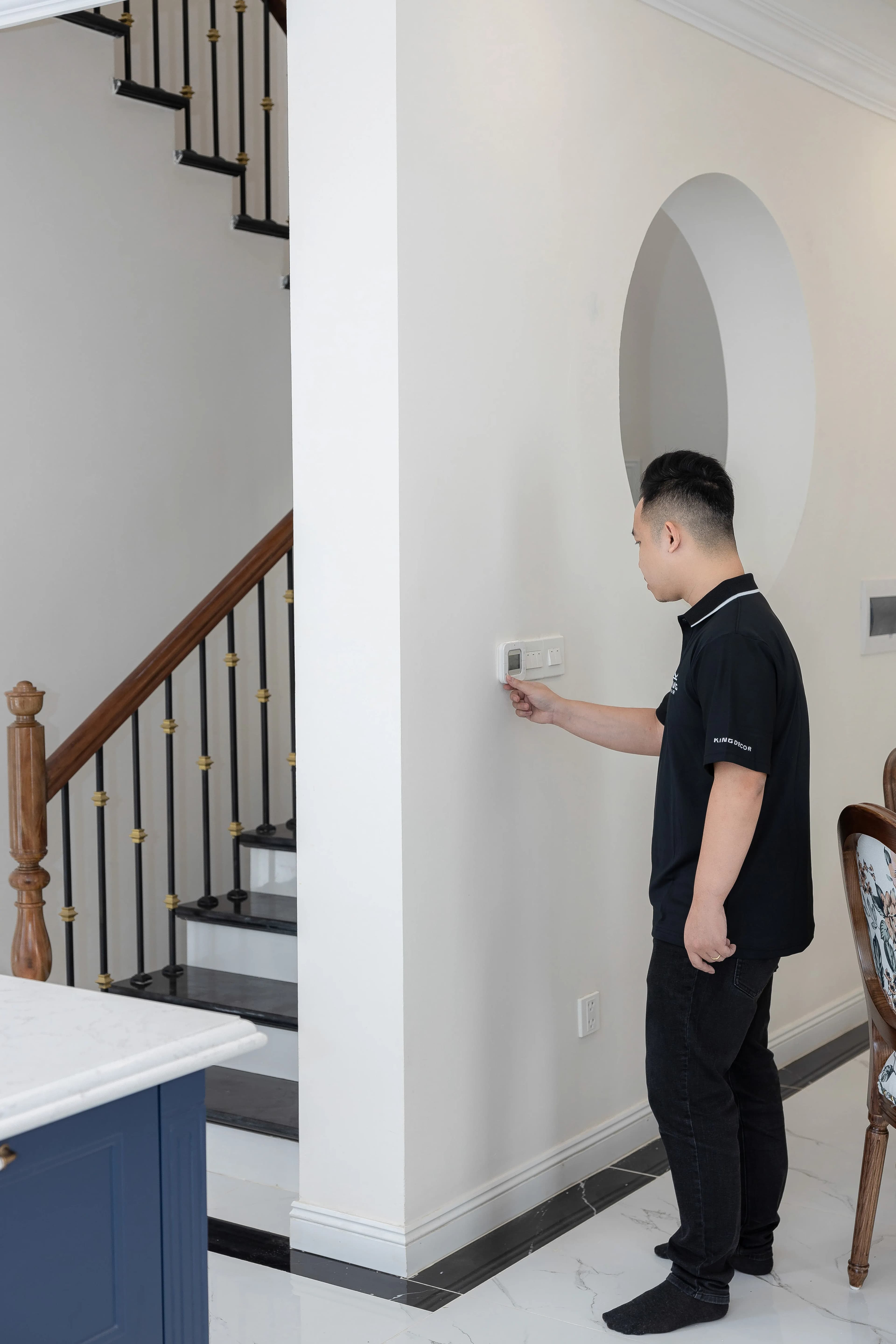
The proof walk
Walk them to the thermostat or the fixture. Show it working. Show the work area cleaner than you found it. Ask: is there anything else you want me to look at while I'm here?
Minutes 9–10
The review ask
Thank them, tell them a short text will come asking how the visit went, and that honest feedback of any kind helps. Then leave.
The order is the point. The two moments likely to be uncomfortable (prices for deferred work, and paying) sit in the middle. The visit ends on the strongest, most concrete good news you have: the system works, the house is clean, and the customer's questions are answered.
Managing the peak when the news is bad
The peak-end research cuts both ways. If the end shapes memory, so does the worst moment, and on many calls that moment is the diagnosis: the heat exchanger is cracked, the water heater is leaking from the tank, the panel is a known problem brand. You can't make that news good. You can keep it from becoming worse than it has to be.
- Lead with evidence, not the price. Show the photo or the reading first. A customer who has seen the crack believes the recommendation; one who hears "you need a new furnace" from a stranger suspects a sales pitch.
- Give a way to buy time when one exists. A safe repair that gets them through the season, priced next to the replacement options, lowers the peak and builds trust. If no safe repair exists, say so plainly and explain why.
- Deliver bad news once. Gather everything you found and present it together during the options step, not as a series of surprises at the door.
- Put it in writing. People under stress don't remember numbers. Leave the options and prices so the decision can happen later, calmly.
When the customer isn't home
Tenants, property managers and customers at work break the sequence. Run the same close-out by text: the recap with photos, the written options, the invoice with a pay link, and the review request the same as any other customer. The proof walk becomes a short video or a photo of the running equipment and the clean work area. The order still matters: send the recap and the proof before the bill, not after it.
Why the recap comes first
The recap does three jobs. It justifies the price before the price appears. It educates the customer, which prevents a whole class of callbacks: in our callback cost post, "customer education" is one of the six cause codes, the call where the system was fine and the customer didn't know how to use it. And it creates the documentation you'll want if a warranty claim or dispute ever comes up.
Photos make the recap fast. A blackened contactor or a swollen capacitor needs no explanation.
Why options belong in writing
Spoken recommendations evaporate the moment the van leaves. Written options with prices give the customer something to think about, show to a spouse, and come back to. The good-better-best estimates post covers how to structure them. For the close-out, the rule is simple: if you found it, write it down and leave it, with prices.
Take payment in the home
Most consumer payments are cards. The Federal Reserve's 2026 Diary of Consumer Payment Choice found consumers made an average of 47 payments a month in 2025, with cash only six of them (14%). For in-person payments, 40% of consumers preferred debit and 38% credit, against 16% for cash.3 A tech who can only take a check, or who says "we'll send you an invoice," is creating accounts receivable out of a payment the customer was ready to make.
Here's what that's worth in a worked example. All inputs are hypothetical.
| Collect at the visit: 80% | Collect at the visit: 95% | |
|---|---|---|
| Completed jobs per year (10 techs) | 10,000 | 10,000 |
| Invoices left to chase | 2,000 | 500 |
| Office time at 15 min each, $32/h loaded | $16,000 | $4,000 |
| Average ticket $450: cash waiting at any time if chased invoices take 30 days | about $74,000 | about $18,500 |
Worked example. The office rate is a BLS-based loaded customer service rate from the callback cost post; all other inputs are hypothetical.
Fifteen hundred fewer invoices to chase and about $55,000 less cash sitting in receivables is worth a minute of a tech's time on every call.
The membership conversation
The best time to offer a maintenance membership is right after you've shown a customer something maintenance would have caught. The worst time is as a scripted line on every call regardless of what you found.
Three rules make it work:
- Tie it to today. "The capacitor that failed was weak at your last tune-up" (if you have that history) or "this is the kind of thing a spring check catches" is honest and specific.
- One offer, one price. If the plan has a discount on today's repair, show the invoice both ways.
- Take no for an answer. The proof walk is next. A pushy membership pitch turns the end of the visit into the peak of the discomfort.
The memberships that renew post covers what makes a plan worth selling.
Asking for reviews within the rules
The review ask is where the close-out most often crosses a legal line, usually without anyone meaning to. Three sets of rules apply.
The FTC's Consumer Reviews and Testimonials rule (16 CFR Part 465) took effect October 21, 2024.4 Among other things it prohibits:
- Fake or false consumer reviews, including reviews by someone who didn't have the experience (§465.2).
- Giving compensation or incentives in exchange for, or conditioned on, reviews expressing a particular sentiment, positive or negative (§465.4).
- Undisclosed insider reviews and testimonials from a company's own people, in the circumstances the rule spells out (§465.5).
- Review suppression, including using threats or intimidation to stop or remove a review, or presenting displayed reviews as representative when negative ones were suppressed (§465.7).
The FTC's guidance for marketers on soliciting reviews is blunt: don't ask for reviews only from customers you think will leave positive ones, and if you offer an incentive, don't condition it on the review being positive.5 Under the FTC's Endorsement Guides, a material connection such as an incentive should be disclosed.6
Google's policy for Maps and Business Profile reviews goes further than the FTC on incentives. It prohibits offering incentives such as payment, discounts or free goods in exchange for reviews, and specifically bans this:
Discourage or prohibit negative reviews, or selectively solicit positive reviews from customers.
| Do | Don't | |
|---|---|---|
| Who to ask | Every customer, the same way, after every completed job | Only customers who seemed happy (review gating) |
| Incentives | Nothing for reviews on Google; a disclosed, sentiment-neutral thank-you elsewhere only if the platform allows it | Discounts, gift cards or entries tied to a review, and anything tied to a positive one |
| Who writes it | The customer, on their own device, in their own words | The tech typing on the customer's phone, or staff reviewing their own company |
| Unhappy customers | A fast call from the office to fix the problem | Pressure, threats or offers to get a review changed or removed |
| Showing reviews | All of them, including the bad ones | A site that shows only five-star reviews as if they were all of them |
Source: FTC 16 CFR Part 465; FTC guide for marketers; Google contribution policy
A private "how did we do?" rating first is common and can be fine, as long as public review links go to everyone regardless of the rating. In TradesWork, review requests go out automatically after each completed job, customers rate privately first, public review links appear for every customer whatever they rate, and low ratings open a same-day office task so someone calls the customer back. The reviews after the FTC rule post goes deeper on the legal details.
Make it a checklist, not a speech
Close-outs drift. A tech who does all six steps in week one does three of them by August, and it's always the same three: the ones that don't involve awkward conversations. A written checklist is the cheapest fix.
The strongest evidence for checklists comes from medicine, not the trades, but it's hard to ignore. When eight hospitals introduced the World Health Organization's 19-item surgical safety checklist, the death rate fell from 1.5% to 0.8% and inpatient complications from 11.0% to 7.0%.7 A close-out isn't surgery, but the mechanism is the same: the checklist makes the easy-to-skip steps visible.
The technician close-out checklist
- Recap: what I found, what I did, with 2–3 photos and the key reading.
- One thing for the customer to watch for this week.
- Deferred problems written up as options with prices and left with the customer.
- Invoice reviewed line by line; questions answered.
- Payment taken in the home, or a pay link sent to the person who pays.
- Membership offered if not a member, tied to today's findings; no taken as no.
- Equipment running, thermostat or fixture shown working.
- Work area cleaner than I found it; old parts removed or left as agreed.
- Anything else to look at while I'm here?
- Review request explained the same way as every other customer; no incentives.
Build the checklist into the job, not onto a laminated card. In TradesWork, the technician app's guided visit flow runs Arrive, Diagnose, Present options, Work and Wrap up, with required photos, forms and the invoice listed at each stage, so a tech can't finish a job with a required item missing. See the technician app.
How to know it's working
Each step of the close-out moves a number you already track or should:
| Close-out step | The number it moves |
|---|---|
| Recap | Callbacks coded "customer education" |
| Options in writing | Close rate on deferred work, 30 and 90 days later |
| Payment in the home | Share of invoices paid at the visit; days sales outstanding |
| Membership offer | Membership conversion rate per tech |
| Proof walk and review ask | Average rating and review velocity, by tech |
Look at them by technician, monthly. The techs with the best close-out numbers are your trainers; have them run ride-alongs with the techs at the bottom. The last ten minutes are the cheapest ten minutes in your business to improve, because the work, the drive and the diagnosis are already paid for.
Footnotes
-
When More Pain Is Preferred to Less: Adding a Better End, Daniel Kahneman, Barbara L. Fredrickson, Charles A. Schreiber and Donald A. Redelmeier, Psychological Science 4(6):401–405, November 1993. ↩
-
Patients' memories of painful medical treatments: real-time and retrospective evaluations of two minimally invasive procedures, Donald A. Redelmeier and Daniel Kahneman, Pain 66(1):3–8, July 1996. ↩
-
2026 Findings from the Diary of Consumer Payment Choice, Federal Reserve Financial Services, May 2026. ↩
-
16 CFR Part 465, Use of Consumer Reviews and Testimonials, Code of Federal Regulations (via Cornell Legal Information Institute); FTC announces final rule banning fake reviews and testimonials, Federal Trade Commission, August 14, 2024. ↩
-
Soliciting and Paying for Online Reviews: A Guide for Marketers, Federal Trade Commission, January 2022. ↩
-
16 CFR 255.5, Disclosure of material connections, Code of Federal Regulations (via Cornell Legal Information Institute). ↩
-
A Surgical Safety Checklist to Reduce Morbidity and Mortality in a Global Population, Alex B. Haynes et al., New England Journal of Medicine, January 29, 2009. ↩